


 7283838383

How to Choose the Best Coaxial Cable for TV in India
Most of the time in Indian residential buildings, cable TV is not paid much attention to until the image quality starts deteriorating, the channels get noisy, or the set-top boxes keep losing the signal. Making a good choice of the coaxial cable for television is just as necessary as picking a reliable DTH or cable operator because a cable is the one that directly brings the audio-video signal to your TV. Having a brand like Microtek already trusted for power backup, solar, and electrical reliability, consumers readily demand that the same level of durability is to be found in the wiring and connectivity standards of their home setups.
What is a coaxial cable, and how does it work?
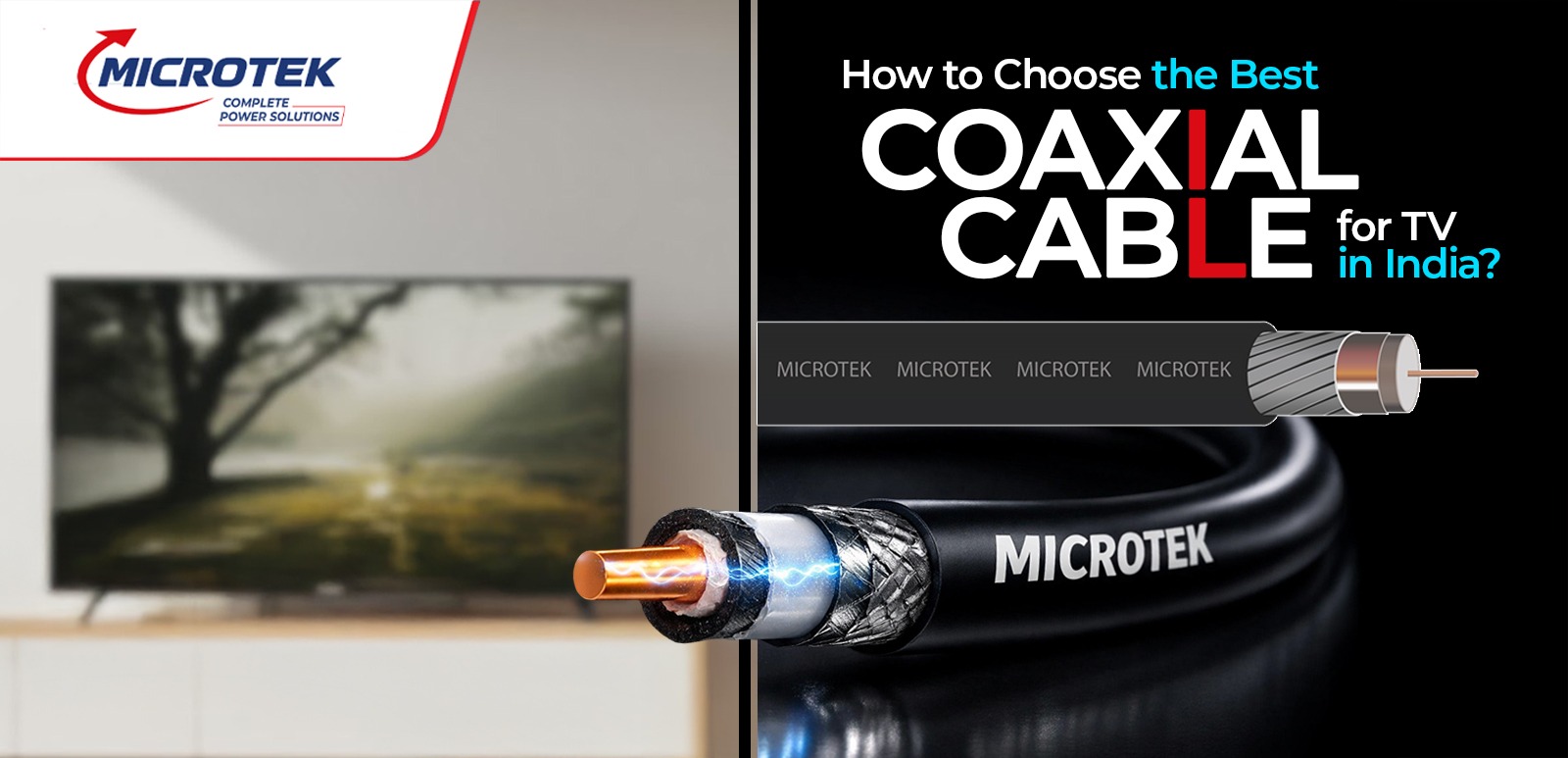
A coaxial cable is an electrical cable specially designed to have a central conductor, an insulating layer, a metallic shield, and a protective outer jacket – all four parts are concentrically arranged and it serves to transmit high-frequency signals with very little loss. The cable’s ability to shield the input from the output noise due to the outside interference is what makes the signal from the wire to the TV or CCTV perfectly usable, showing the indispensable character of such a cable, especially in the crowded Indian residential areas, where heaps of electrical wires, Wi-Fi routers, and other electronic devices are found.
In the case of TV and coaxial cable for CCTV, the best impedance value is 75 ohms, which is quite suitable for video and broadcasting applications. The point at which wrong impedance-resistant cables are attached is when signals could be diverted back, thus leading to ghosting, pixelation, or untraceable signal drop on the TVs.
Common coaxial cable types in India
Two types of cables are mainly referred to in Indian residential buildings and small commercial office premises, i.e., coaxial cables RG59 and RG6. RG59 is a thin one and has been traditionally used in the development of older analogue TV and basic coaxial cable for the CCTV industry, while RG6 is a thicker one, capable of higher frequencies, and is already the one selected for HD, DTH, and digitally based cable TV connections.
A lot of Indian producers and suppliers create CCTV-dedicated RG59, while RG6 is used for TV, DTH, and broadband, usually with better noise protection through the shielding. In some places, larger houses, villas, or small business areas, the use of longer cable runs of RG11 is preferable since it lowers the attenuation over the distance, but the cable is more rigid and costly.
TV vs CCTV: where does each cable fit?
In most cases, the ideal coaxial cable for TV in a household is typically RG6, as it is able to carry satellite TV, digital cable, and even broadband signals over moderate distances without significant attenuation. Besides, RG6 is often provided with a better combination of shielding, which is very helpful in the maintenance of HD and 4K quality in the flats where there are a lot of electronic interferences.
As far as the coaxial cable for CCTV is concerned, RG59 has been the standard in the industry for the most part, especially when it comes to the cameras that are analogue and the majority of the DVR systems that are traditional. For high-definition CCTV or long-distance camera runs, installers might use high-grade RG59 or even RG6 so that the connectors and the DVR or NVR specs can be compatible with the cable that is being used.
Shielding and build quality: why they matter
Shielding is the measure of the extent to which the coaxial cable is capable of protecting the inner signal from the various sources of electrical and radio-frequency noise that are present in the external environment. Those cables with a single screen are equipped with only one shield layer, and they may be good enough for short indoor TV connections. On the other hand, double-screen or multiple-shield cables are advised for HD TVs and longer runs to lessen the impact of interference. The need for better shielding arises mainly due to the fact that in Indian cities, the buildings are very close to each other, and thus the lifts, motors, and inverters present in them are the sources of electromagnetic noise, which ultimately leads to the interference of weak TV signals.
The quality of the outer layer is also of great importance due to the fact that cheap plastics may lose their strength gradually when they are subjected to high temperatures, direct rays of the sun, or damp walls. By selecting a cable manufactured by a well-known electrical brand and at the same time pairing it with reliable Microtek power backup and stabilizer solutions, not only will your overall home electronics be protected from voltage spikes, but also from physical wear.
Connectors, installation, and distance
The best coaxial cable for TV will not be able to work as expected if poor-quality connectors are utilized or if the joints are loosely crimped. F-type connectors are the ones that are commonly used for TV and DTH; they ought to be of the same size as the cable, and also, they must be properly tightened in order to prevent signal leakages. In the case of CCTV, BNC connectors are the ones that are typically found on RG59 cable, and, as a result, the proper crimping or compression is what leads to camera feeds that are stable and the calling of maintenance staff being at a minimum. Cable length is another factor that can lead to reduced performance, as every meter brings a little bit of signal attenuation.
When the antenna or dish is placed on the terrace, and the living-room TV is quite far, making use of RG6 or RG11 and not doing any extra joints or splitters are some of the things that help keep signal strength and picture clarity intact.
Safety, durability, and brand trust
The quality of the signal is not the only thing that defines a good coaxial cable for CCTV or TV. The cable should also be safe and reliable over the long term when placed inside the walls and ducts. A lot of modern coaxial cables are made to be resistant to fire and produce even when they do, some low-smoke and non-toxic fumes. This is very important in the case of tall buildings and large commercial spaces. Using such a cable along with the Microtek power backup, solar, and stabilizer ecosystem will make the entire electrical system safe and stable, not only at home but also at the office.
Moreover, Indian consumers can get even more advantages if they decide to purchase products from brands that have good service networks, reliable products, and provide detailed technical specifications, especially in situations where the TV distribution and CCTV monitoring are combined. This method of working eliminates the chances of constant rewiring, picture interruptions, and compatibility problems with such devices as TVs, set-top boxes, DVRs, and routers.
How to choose the best coaxial cable for TV in India
Determining the best coaxial cable for TV should begin with first knowing the type of connection: DTH, cable TV, or rooftop antenna, and then selecting RG6 with good double shielding for most modern digital setups. Besides, one should verify the cable impedance (75 ohms), the jacket material, and the manufacturer's reputation. Moreover, the cable should be as short as possible with minimal bends and no extra connectors to keep the signal at its strongest level.
In case the same location is used for both a coaxial cable for CCTV and a TV, then it is important to ensure that CCTV runs employ proper RG59 or specified HD-rated coax with separate, clearly labelled routes from the TV cabling. Working on this together with competent electricians and trustworthy brands in power and electrical solutions keeps the system in good working condition and makes it easy to extend it with higher-resolution TVs or cameras in the future.
Conclusion
By simply choosing the right coaxial cable, you can dramatically change your day-to-day TV and CCTV experience in a very positive way. This is achieved by noise reduction, better clarity, and longer system life. The consumers in India can purchase the best coaxial cable for TV as well as the most appropriate coaxial cable for CCTV in their homes and offices if they follow as guidance: knowing the differences between RG59 and RG6, paying attention to the shielding quality, using the correct connectors, and trusting well-known electrical brands like Microtek for the general power and wiring ecosystem.
- Copy :
 Copy Link